Our Production
Printing Department
Welcome to the Printing Department page of the “Design-Print Ukraine” printing house! We are glad that you have chosen us for your printing needs. Our company uses the latest technologies and equipment to provide you with high-quality services.
Our printing shop is equipped with modern equipment that allows us to perform a wide range of printing tasks. We offer offset and digital printing, as well as paper cutting and finished product trimming.
Here are some of our key machines:
• Offset 5-color sheetfed press with coating unit – Komori Lithrone 528.
• Offset 4-color sheetfed press – Komori Lithrone 428.
• Digital A3 printing press – Xerox Versant 80 Press.
• Single-knife paper cutter – Perfecta 115.
We strive to provide you with the best cooperation experience, which is why we constantly update our equipment and improve the qualifications of our employees. Thanks to this, we can guarantee fast order execution and high product quality.
We look forward to your order and are ready to answer all your questions. Thank you for choosing “Design-Print Ukraine”!
Offset printing is a printing technology that involves transferring ink from a printing plate to a printing material not directly, but through an intermediate offset cylinder. It is performed using the CMYK color model, which allows using three basic colors (C (Cyan) – cyan, M (Magenta) – magenta, Y (Yellow) – yellow) and black to obtain most colors visible to humans, as well as various shades obtained by mixing the main basic colors.
Screen printing is one of the simplest types of special printing. The main feature of screen printing is that it can print on different materials, not only on a flat surface, but also on various geometric surfaces, while also regulating the ink layer thickness. However, it should be noted that screen printing is performed only in one ink (Pantone) per pass. The difference between these types of printing lies primarily in the application technology, printing speed, and color range of the products.
Fluorescent inks are a special type of inks that absorb ultraviolet light and emit bright colors. Their main feature is fluorescence, where they absorb short-wave light and emit long-wave light. Fluorescent inks are used for various purposes, such as marking objects, promotional materials, warning signs, and are often used at parties or in clubs to create a vibrant effect in low-light conditions or under ultraviolet light.
Thermochromic inks are a special type of inks that change color under the influence of temperature, for example, they can become brighter or change color from warm to cold and vice versa. They are used in the printing industry, clothing design, medicine, and toys, and can be used for temperature indicators or for decorative and entertainment purposes, such as on magnets or calendars.
Pantone is a system of standardized colors used in design and printing. Each color has a unique number and formula for accurate reproduction. Pantone differs from the CMYK system (which uses a combination of primary colors to create a wide spectrum) in that it allows colors to be precisely specified for printing special elements, such as logos or brand colors, ensuring consistency of reproduction.
Printing using the “4+0” and “4+4” formulas refers to printing methods that determine the number of colors used on both sides of the printed material. 4+0 printing means that four CMYK colors (cyan, magenta, yellow, black) are used on one side of the printed material, while the reverse side remains unprinted or blank. 4+4 printing means that both sides of the printed material will be printed, each with four CMYK colors.
A printing formula can include more than 4 inks when the printing of a product involves applying special color shades that cannot be represented by the CMYK color model. Such shades are rendered with pre-mixed colors – Pantones. So when the printing formula specifies printing in five or 8 inks (5+0 or 8+0), it means that the printing is performed with the 4 basic CMYK inks plus one or 4 additional Pantones, respectively.
Food-grade inks in printing are used for printing on food packaging and comply with safety standards. They must be resistant to moisture, light, and other factors that may arise during production and transportation. It is also important that they accurately reproduce colors on packaging, ensuring an attractive appearance of the products.
Post-press Department
Welcome to the Post-Press Department page of the “Design-Print Ukraine” printing house! We are glad that you chose us for your printing needs. Our company uses the latest technologies and equipment to provide you with high-quality services.
After the printing process, the printed sheets are moved to the post-press finishing department. The following processes are performed in this department:
• Die-cutting
• Embossing
• Congreve embossing
• Mounting (gluing two or three materials together)
• Lamination (the process of applying a glossy or matte film to printed sheets)
Let’s take a closer look at each of these processes:
1. Die-cutting: This is a process in which a special form (cutting die) is used to give the product a specific shape. Die-cutting is used to create unique shapes and designs that help the product stand out.
2. Embossing: Embossing is the process of applying a pattern to the surface of a material using high pressure. This can be used to create a relief image on the surface of the product, adding aesthetic value.
3. Congreve embossing: Congreve embossing is the process of adding volume to individual elements of the product. This is achieved using special equipment that heats and shapes the material.
4. Mounting: Mounting is the process of gluing two or more layers of material together. This allows for the creation of stronger products that are more resistant to external influences.
5. Lamination: Lamination is the process of applying a protective film to the surface of the product. This can be used to protect against scratches, stains, and other damage. Lamination can be glossy or matte, depending on the desired appearance of the product.
The post-press finishing department operates the following equipment:
• Die-cutting machine (platen type) ML-750
• Die-cutting machine (platen type) ML-720
• Die-cutting machine (platen type) ML-1100
• Die-cutting machine (platen type) ZHHJ-1040
• KAMA TS 96 automatic die-cutter
• Svecia screen printing machine
• UV dryer
• Heidelberg hot foil stamping machines (cylinder type)
• YDFM-720 roll laminator
• Perfecta 92 single-blade paper cutter
• Calender and JS720 gluing machines
We strive to provide you with the best experience of cooperation, so we constantly update our equipment and improve the qualifications of our employees. Thanks to this, we can guarantee fast order execution and high product quality.
We look forward to your order and are ready to answer all your questions. Thank you for choosing “Design-Print Ukraine”!
Lamination — when maximum protection is needed (business cards, menus, covers, frequently handled items, die-cutting, creasing) or a soft-touch effect.
UV varnish — when super gloss, spot highlighting of elements (logo, headline) is important, or when the budget is limited for large print runs.
The best premium option is matte lamination + spot UV varnish.
Embossing is a technique that creates a raised (convex) image using two dies: a stamp and a counter-die. For this, the material to be embossed is placed between these dies, and an impression is made under press pressure. Embossing can raise the image, making it tactile, which is often used to create impressive and stylish printed products.
Blind debossing is a technique in which a recessed image is produced on a product using a die heated to a certain temperature, due to the significant penetration of the die into the material and the smoothing of its texture. This debossing is performed without ink or foil, creating recessed image elements that lie virtually in one plane. This method differs from embossing by using only a single die, as well as the impossibility of using additional finishing materials when performing this stamping technique.
Yes, when creating a design, various surface finishing techniques can be used simultaneously to highlight the same elements on a product. For example, you can apply embossing (or blind debossing) to create raised images or text, and add UV varnish for extra impact and shine. Also, for example, foil stamping can be added to text raised by embossing to create an additional visual effect. Such combinations can be particularly successful for creating printed products with a high degree of detail and sophistication.
Score cutting (half-cutting) refers to applying a shallow scratch with the tip of a knife blade to set the direction of the fold during assembly. In fact, this is an operation of cutting up to half the thickness of the material. The cut is made to 1/2 or 2/3 of the cardboard thickness, so one layer of material remains intact. Score cutting is used in cases where it is necessary to neatly bend a very dense paper blank in different directions along a complex contour or fold thick cardboard.
Creasing is the creation of a straight groove on a sheet of material by pressing. It helps fold heavy paper grades and cardboard at various angles, while preventing the ink layer from cracking and avoiding excessive deformation.
Regarding their differences, although score cutting, like creasing, is performed along the fold line, the score cutting method still involves not just creating a groove, but cutting into the cardboard for subsequent folding.
The most common method of applying Braille to cardboard packaging is embossing. For this purpose, special embossing dies with raised dots are used, which create raised Braille images on the surface of the cardboard.
A soft souvenir magnet is created by mounting magnetic vinyl and laminated cardboard that is already printed with various images or text. This process allows combining the magnetic properties of vinyl with the strength and stability of cardboard, creating an attractive and functional souvenir for everyday use or as a gift.
Rigid (hardcover) packaging with perfectly straight, smooth edges at a 90-degree angle can be produced using a grooving machine through a technological process known as milling. First, parts are cut from high-quality material, such as cardboard. Then, using a router, clean and straight angles are made, forming the edges of the package at a 90-degree angle. After that, the parts are assembled and glued together, forming a rectangular package with perfectly straight, smooth edges. This process ensures high precision and quality of the final product.
A scratch-off coating is a special coating on printed materials used to hide information or add an element of intrigue, such as on lottery tickets or promotional coupons. This coating can be peeled or scratched off to reveal hidden elements such as text or images. There are several ways to apply a scratch-off coating, such as applying a pre-made coating or using a special foil coating. This coating technology helps increase the appeal and effectiveness of printed materials in marketing campaigns.
Slim cardboard is a thin yet durable material created by mounting layers of paper or cardboard together using special adhesives. It offers advantages when used in printing due to its thinness, strength, flexibility, and lightness. Slim cardboard provides an elegant look to printed materials such as packaging, brochures, flyers, business cards, boxes, game boards, or promotional materials compared to binder board, by preserving the white edges of the product. It should also be noted that with slim cardboard, you can achieve any desired thickness (density) of the product.
folding and gluing line
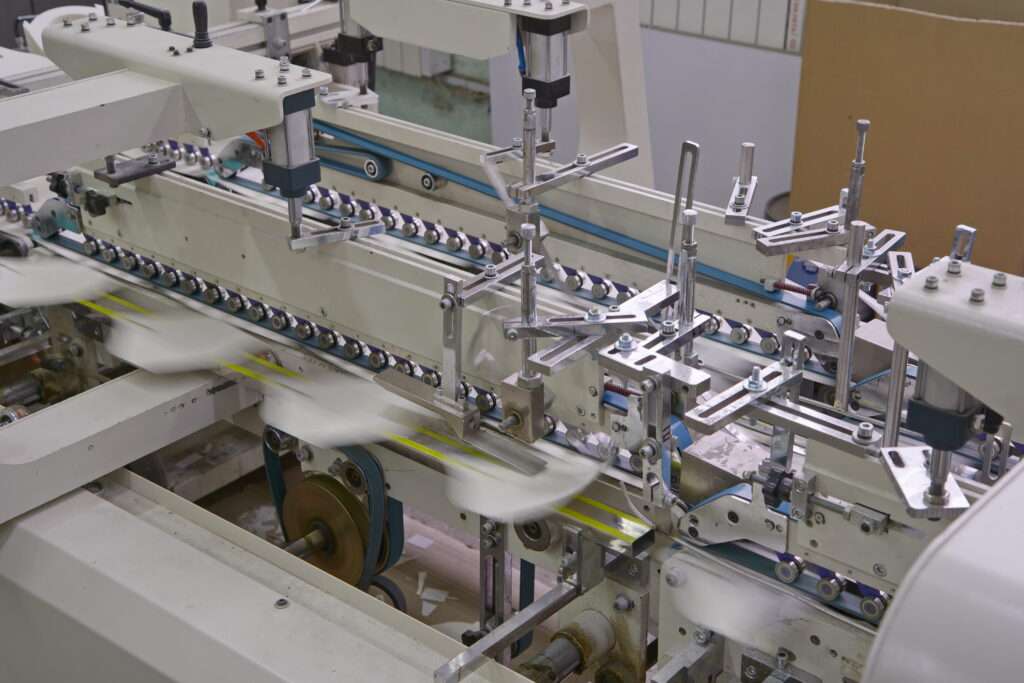
We are pleased to welcome you to the website page of our printing house “Design-Print Ukraine” – Packaging Assembly and Gluing Workshop. This workshop is an important part of our printing production process.
The following processes are performed manually in this workshop:
• manual assembly;
• packaging;
• tape gluing.
Equipment operated in this workshop:
• MBO folding machines: These machines are used for folding, the process of folding a printed sheet to form an even crease. Folding is important in the production of booklets, leaflets, flyers, as well as catalogues and books.
• MultiEffect folding machine: This machine is also used for folding, but it may have additional functions or specialized settings1.
• MBO folding machine (large): This large machine is used for folding large sheets of paper or for performing large volumes of work.
• FSL (folder-gluer line) GDHH 800: This equipment is used to automate the folding and gluing process.
We strive to provide our customers with the highest quality products. We are always happy to accept your orders and are ready to answer all your questions regarding our technologies and equipment. Thank you for choosing our company!
On folder-gluer lines (FSL), gluing takes place using specialized mechanisms and technologies. The main process consists of several stages, namely: the stage of preparing materials/blanks and placing them on the line, the folding stage, and the glue application stage. Next comes the actual gluing itself, during which parts of the blank are joined together using presses and then move further along the line directly into boxes for packaging and shipping. If necessary, after gluing, the product can undergo additional processes, such as cutting or shaping, to complete the manufacturing of the product.
Usually at our enterprise, products such as boxes with one, two, and three gluing points, cardboard folders, paper bags, wrappers (sleeves) for boxes, and paper envelopes are glued on the FSL.
The minimum paperboard density for gluing on an FSL should not be less than 215g/m2. The maximum thickness should reach no more than 400g/m2.
Flow-pack
We are pleased to welcome you to the webpage of our printing house “Design-Print Ukraine” – Custom Packaging Workshop. This workshop is an important part of our printing production process.
In this workshop, the process of stripping products from waste and subsequent packaging in BOPP film takes place. The following equipment is operated in the workshop:
• Horizontal packaging machines ALD-250 X, “Beta”_1, “Beta”_2, QP-K-3B_1, QP-K-3B_2 – for packaging products in a horizontal position.
• Horizontal packaging machines “BASIS” (for packaging products of various sizes): DCWB-320 D, DCWB-250 D.
• Feeders “S 1250EX” – for automatic feeding of products into the packaging machine.
• Oil air compressor BAMBI – to generate compressed air used in packaging machines.
This workshop is an important part of the printing production process, as it provides individual packaging for each product, guaranteeing its safety during transportation and storage or its advertising and sale in this packaging. We use the latest equipment and technologies to ensure the high quality of our products.
We are always happy to accept orders and ready to answer all your questions. Contact the professionals!
Flow-pack is the individual packaging of each item into three-seal bags. Such bags are sealed and protect the product from moisture, and when using metallized films, also from UV rays penetrating inside the package. This packaging is used for a vast number of product groups in the food, cosmetic, and non-food industries. Any piece product that can be placed on a conveyor belt can be packaged this way.
Most often, our company flow-packs products such as magnets and magnetic bookmarks, lottery tickets, cards, and chips.
Bookbinding Department
Welcome to the page of our printing house website Design-Print Ukraine — Manual Operations Shop. This shop is an important part of our printed products manufacturing process.
In this shop, various processes are performed, divided into two categories: machine-assisted and manual.
Machine-assisted processes include staple binding of products. This is done using our dual-head wire stitching machine 4BSH 30/2 and BSH-30, which can stitch book and magazine products with a maximum stitching thickness of 8 mm.
Manual processes include packaging, tape gluing, hot melt gluing, spring assembly, collating, and labeling.
We use a variety of equipment in this shop, including the Joyner JYS5.5 riveting machine for installing metal eyelets (grommets) on products, the DC-460 manual creasing machine for applying crease lines, the BY-600 puncher for punching holes for spirals, the Uchida VS-25 paper drill for making holes in paper stacks, the QY-30 corner rounder for processing printed materials, a manual binder for making perforation holes and crimping products when attaching blocks with a spring, the EKH-455 chamber shrink wrap machine for packaging various products in shrink film, and the BS-6535LA shrink tunnel for shrinking all types of shrink films.
We strive to provide our customers with the highest quality products, and our Manual Finishing Shop helps us achieve this. We are always glad to receive your orders and are ready to answer all your questions regarding our technologies and equipment. Thank you for choosing our company!
Assembling a paper bag using tape or hot melt glue in the manual operations shop includes unfolding the bag blank on the work surface, applying tape or hot melt glue to one of the edges, folding the bag to join the edges, and pressing to ensure a strong bond. Next, eyelets and handles are inserted into the bag. After this, quality control is carried out, and the finished bags are packaged and labeled for further use or shipping.
The process of manufacturing a tent-style desk calendar includes design development and printing of calendar pages. Next, to ensure durability, the pages are laminated and decorated with various printing effects. Then, the pages are cut, perforated, sorted, and prepared for assembly. During assembly, the binder base of the calendar is mounted first, then the calendar block and other attributes, such as note blocks or color stickers, are attached to it with a spring. The final stage is quality inspection, packaging, and labeling of the calendar.
First, the cards are manually sorted by the company’s employees according to their type, value, or suit, depending on the game concept. This may include separating cards by color, number, or other characteristics. After sorting, a secondary quality control is carried out to ensure that all cards meet production quality standards. Then the cards are assembled into one or more decks according to the Customer’s layouts and packed into a box ready for sale. If necessary, the deck of cards is also secured with a PET band, placed in a zip lock bag or an adhesive flap bag, or shrink-wrapped in film to prevent the deck from scattering when opening the packaging.
Why Choose Us
Experience
20 years in the printing services market
Certification
Certifications
ISO 9001:2015
Raw Materials
raw materials
Quality
5 levels of quality
control
Geography
Delivery across Ukraine and
abroad
CERTIFICATION
SMETA Certificate